Mechanics to finite elements
Stress, strain, energy, weak forms, interpolation, element formulations and Gauss integration.

FEACORE · ENGINEERING SIMULATION
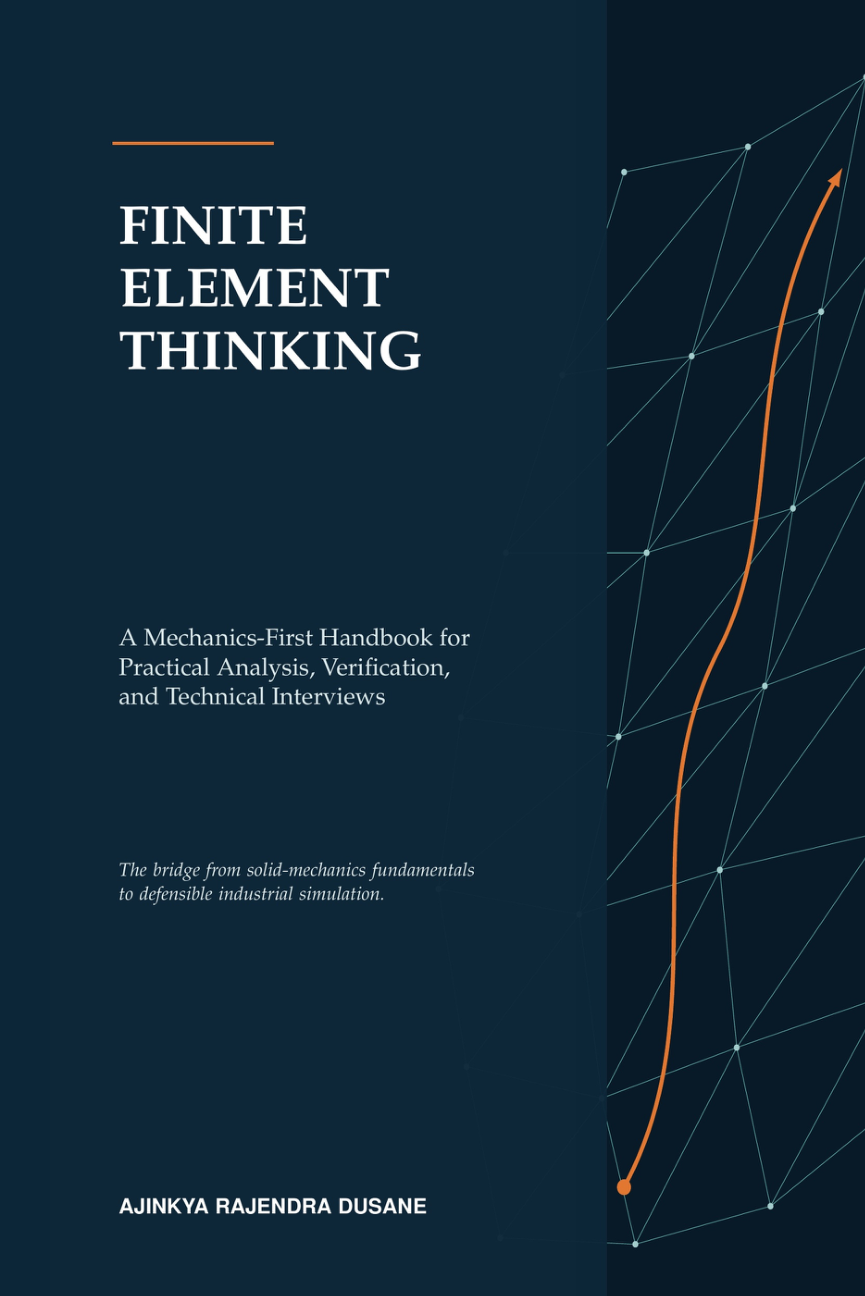
BOOK BY AJINKYA RAJENDRA DUSANE
A Mechanics-First Handbook for Practical Analysis, Verification, and Technical Interviews
Connect solid-mechanics fundamentals with the judgement needed to build finite element models you can explain and verify. A software-independent reference for learning, model reviews and technical interview preparation.
Check Amazon for the current price and available edition.
Stress, strain, energy, weak forms, interpolation, element formulations and Gauss integration.
Meshing, boundary conditions, contact, material and geometric nonlinearity, and solver convergence.
Vibration, buckling, fracture, fatigue, thermal stress and multiphysics coupling.
Analytical benchmarks, diagnostic checklists, modelling algorithms, scientific schematics, element tables and a seven-day interview revision route.
Engineering students: connect mechanics and finite-element theory with practical modelling choices.
CAE engineers: revisit assumptions, numerical checks and the interpretation of results.
Postgraduate researchers: strengthen the reasoning behind model formulation and verification.
Interview candidates: organise technical revision around mechanics, analysis and defensible engineering decisions.
The emphasis is on understanding the model: what it represents, how it is solved, which checks it needs and where its limitations lie. Benchmarks and diagnostic checklists support structured analysis reviews, while the visual material and interview route support revision.
A mesh convergence study that answers the right question →