

COMPUTED DEMONSTRATION / 1D BEAM FINITE ELEMENTS
Cantilever beam under a distributed load
A reproducible numerical verification study using cubic Hermite Euler–Bernoulli beam elements.
Problem definition
A 200 mm long beam with a 20 × 10 mm rectangular section is fixed in displacement and rotation at x = 0 and free at x = 200 mm. The downward uniform load is 1 N/mm. The elastic modulus is 210,000 MPa; the second moment of area is 1,666.667 mm⁴.
The model assumes linear elasticity, small deflection and negligible shear deformation. This is a one-dimensional beam model, not a 3D solid or a connection assessment.
Formulation & analytical reference
Each node has transverse displacement and rotation degrees of freedom. Element stiffness follows the integral of EI times the product of shape-function second derivatives. A consistent nodal load vector represents the distributed load. The reduced global system is solved after enforcing the fixed-end conditions.
v(L) = qL⁴/(8EI) = −0.571429 mm
The support reaction is 200 N and its moment is 20,000 N·mm. The analytical root bending stress magnitude is Mc/I = 60 MPa; this nominal beam stress does not represent a local 3D support stress.
Computed results
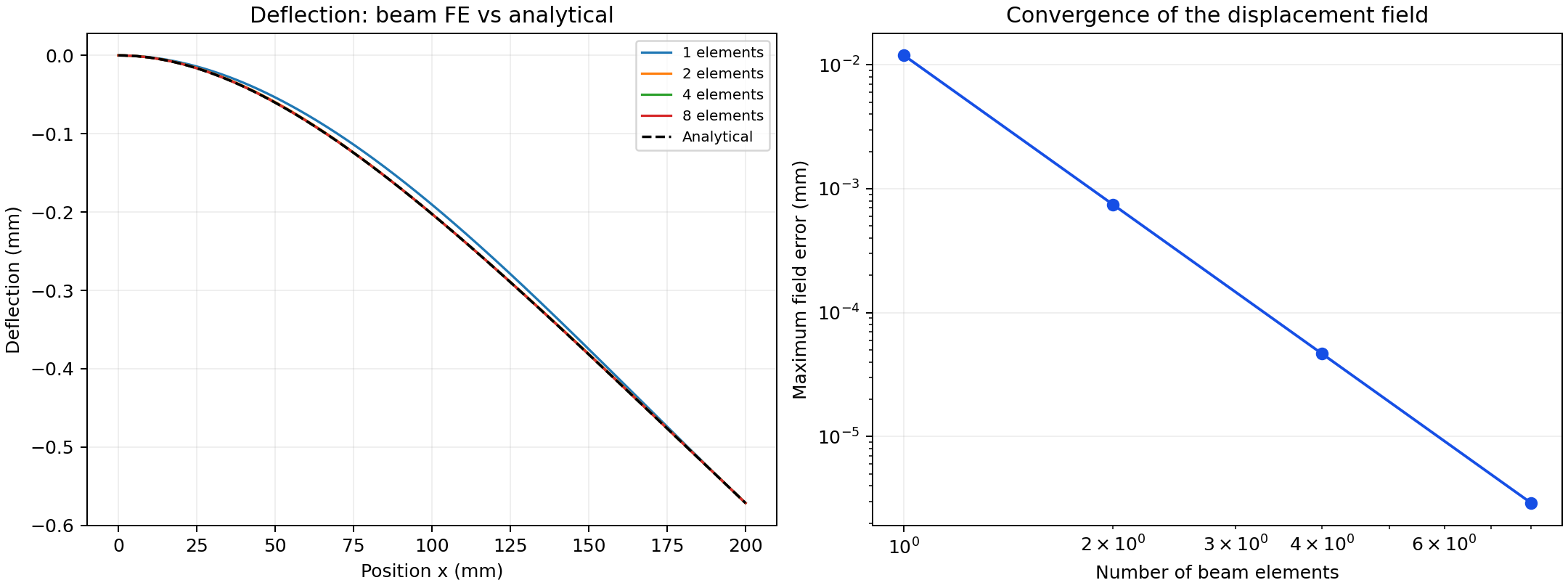
| Elements | Tip displacement (mm) | Maximum field error (mm) | Error / exact tip (%) |
|---|---|---|---|
| 1 | −0.571429 | 0.0119048 | 2.08333 |
| 2 | −0.571429 | 0.000744048 | 0.130208 |
| 4 | −0.571429 | 0.0000465030 | 0.00813802 |
| 8 | −0.571429 | 0.00000290644 | 0.000508626 |
Field error is sampled at 401 equally spaced positions. For this particular uniform-load beam benchmark, the nodal tip displacement is reproduced to numerical precision even on a coarse mesh. The between-node displacement field still has interpolation error. Tip displacement alone would therefore conceal that error.
Verification & conclusion
All four models satisfy the reaction-force and moment checks within the scripted tolerances. Refinement reduces the maximum sampled displacement error by about a factor of 16 per mesh doubling. This demonstrates the expected behaviour for this smooth beam problem; it is not evidence of accuracy for arbitrary geometry or nonlinear materials.
This study is numerically verified against an analytical beam solution. It is not experimentally validated, and does not assess yielding, buckling, fatigue or joint compliance.